


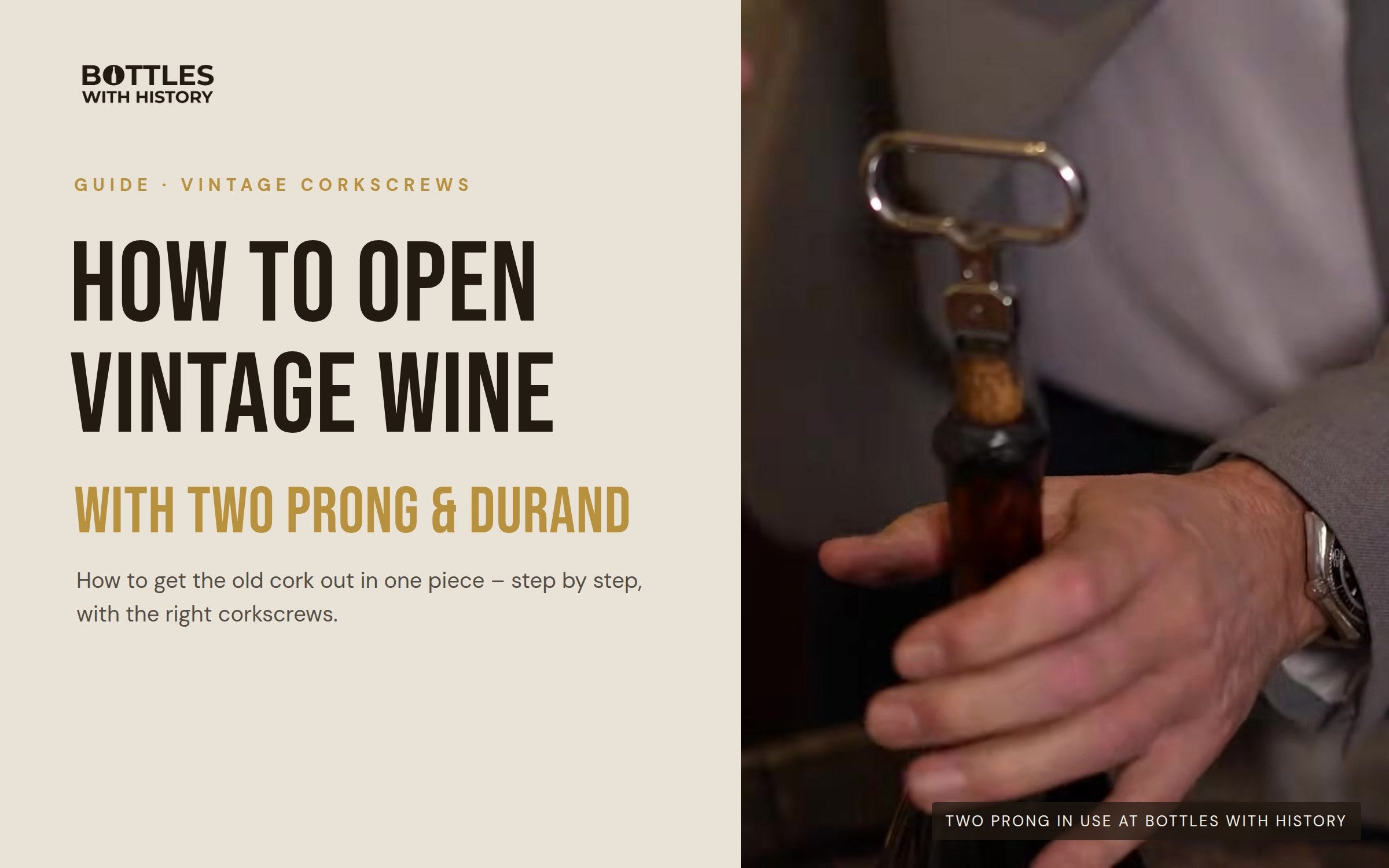
An old bottle deserves a good start. But a cork that has sat in the neck for 30 or 40 years does not behave like a new one. It can be soft, dry or brittle, and an ordinary corkscrew can easily split it or push bits of cork into the wine.
That is why there are two special tools for older bottles: the two prong and the Durand. In this guide we explain how they work, when to use them and how to do it step by step.
Why are old corks so difficult?
Cork is a natural material, and it changes over the years. The Flora Springs winery writes that a cork gets softer with age. Sommelier Drew Brady tells VinePair that over time the cork almost “becomes part of the bottle”, and that its strength drops noticeably somewhere between 15 and 30 years.
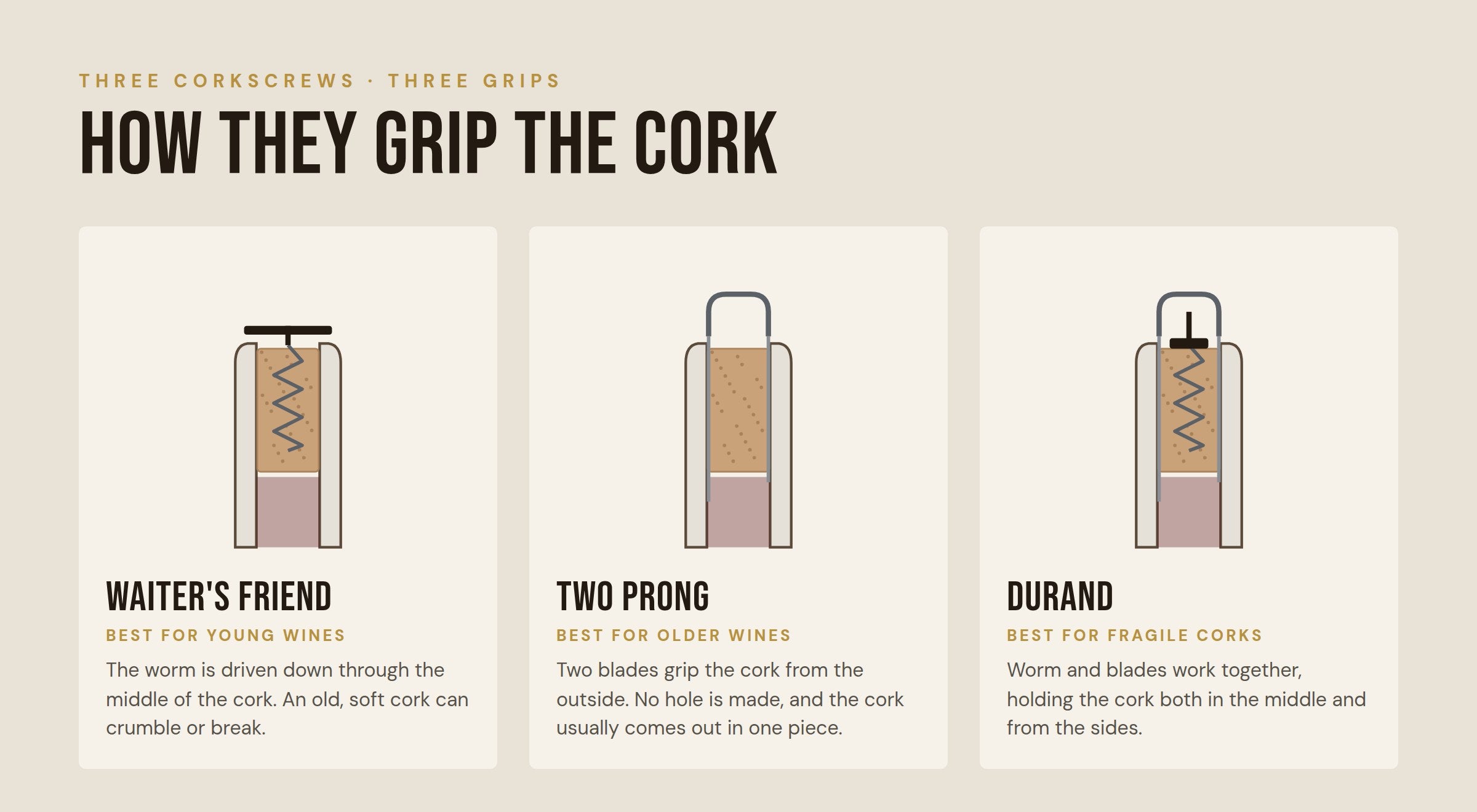
The problem with an ordinary corkscrew is that the worm is driven down through the middle of the cork. In a young, firm cork that is perfectly fine. But in an old, soft cork the worm can tear loose, so the cork breaks or crumbles.
Two prong – the corkscrew without a worm
A two prong (also called an Ah-So or Butler's Friend) has no worm. Instead it has two thin metal blades of different lengths. The blades slide down between the cork and the glass, one on each side. When you twist and pull, the cork comes up, held tight between the blades.
A little history
The idea is old. As early as 1879, Lucian C. Mumford, an American from San Francisco, was granted a patent for a cork puller with two thin blades. He pointed out that unlike a corkscrew, it did not damage the cork, so the cork could be used again.
The name “Ah-So” is said to come from the German exclamation “Ach so!” – roughly “oh, I see!” – and it was the name under which the German maker Monopol sold it in the USA. In England it is called the Butler's Friend. According to an old legend, the household butlers used it to taste the master's wine and put the cork back in without anyone noticing.
How to use a two prong
We use a two prong ourselves when we open old bottles in our warehouse. The pictures here are from our own guide.
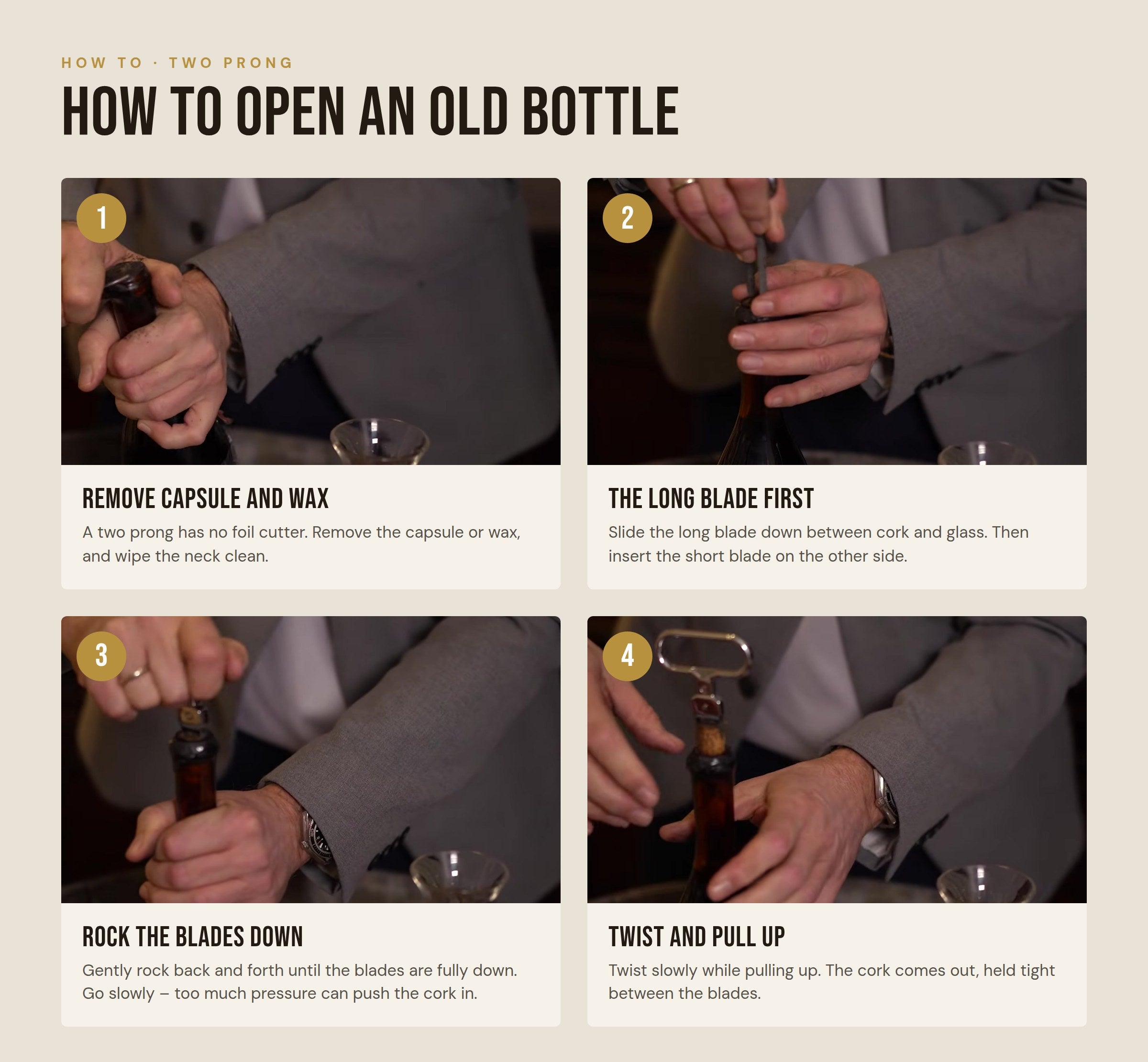
- Remove the capsule and wax. A two prong has no foil cutter, so remove the capsule or wax first. Wipe the neck clean.
- The long blade first. Slide the long blade down between the cork and the glass. Then insert the short blade on the other side.
- Rock the blades down. Gently rock back and forth until the blades are all the way down. Go slowly – too much pressure can push the cork into the bottle.
- Twist and pull up. Twist slowly while pulling up at the same time. It helps to hold the blades and the cork with two fingers as you twist.
Pros and limits
| Two prong | |
|---|---|
| Good for | Older wines with soft or fragile corks |
| The cork | Usually comes out in one piece, with no hole |
| Can the cork be reused? | Yes, it can be twisted back into the bottle |
| Not suitable for | Screw caps, glass stoppers and synthetic corks |
| Watch out | Too much pressure can push the cork into the bottle |
Wine Spectator's James Laube calls the two prong “a far safer way to open older bottles with delicate corks”.
Durand – worm and blades in one
The Durand was invented by Mark Taylor, an American wine collector from Atlanta with a background in engineering. It came on the market in 2007 and is named after the sommelier Yves Durand, who was Taylor's friend and mentor.
The idea is simple: the Durand combines a worm with a two prong. First you screw the worm into the middle of the cork. Then you slide the two blades down the sides. When you twist and pull, the cork is held both from the centre and from the outside. The worm has a crossbar that is wider than the mouth of the bottle, so the cork cannot be pushed into the bottle.
Wine critic Antonio Galloni of Vinous calls it “an absolute must for anyone who loves opening and drinking older wines”. The quote is on the maker's own website.
Step by step with the Durand
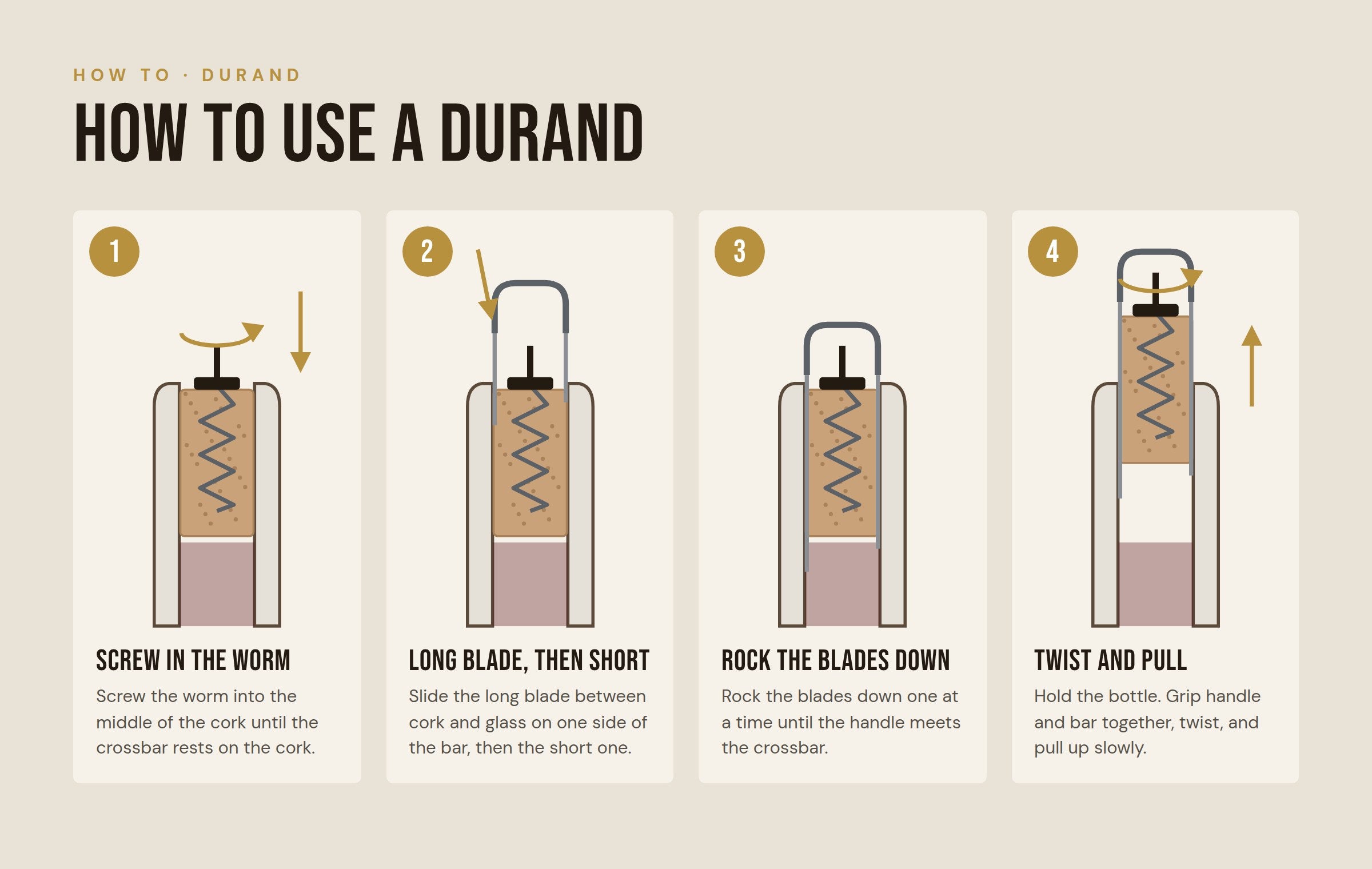
- Screw in the worm. Screw the worm into the middle of the cork until the crossbar rests on the cork.
- Long blade, then short. Slide the long blade down between the cork and the glass on one side of the bar, then the short one on the other side.
- Rock the blades down. Rock the blades down one side at a time until the handle meets the crossbar.
- Twist and pull. Hold the bottle firmly. Grip the handle and bar together, twist, and pull up slowly while you keep twisting.
If the cork is very fragile, you can support it with your fingers at the neck at the end. The maker stresses that the Durand is meant for older, fragile natural corks.
Which corkscrew should you choose?
The experts do not fully agree on when to switch from an ordinary corkscrew. Drew Brady recommends an ordinary corkscrew up to about 15 years and a two prong after that. Others recommend a two prong from as early as 10 years. Our rule of thumb looks like this:
| The bottle | The cork | Choose |
|---|---|---|
| Young wine, up to about 10–15 years | Firm and springy | Waiter's friend |
| Older wine, over about 15 years | Soft or dry | Two prong |
| Very old wine | Fragile, crumbling or already broken | Durand or our Two Prong Pro |
| All ages | Synthetic cork, screw cap or glass stopper | Not a two prong or Durand |
Good advice before you open an old bottle
- Stand the bottle upright for a few days. That gives the sediment time to sink to the bottom before you open it.
- Turn the tool, not the bottle. Pull straight up, and take your time.
- Mould on top of the cork is usually harmless. It typically just means the bottle has been stored somewhere damp. Wipe the rim with a damp cloth once the cork is out. Mould on the underside of the cork is the warning sign.
- If the cork crumbles anyway, pour the wine through a fine sieve or a coffee filter.
If you are new to older wines, our guide to vintage wine gives a good overview of what to expect once the bottle is open.
Corkscrews from Bottles With History
We sell corkscrews for both young and old wines:
| Corkscrew | Type | Best for |
|---|---|---|
| Vintage Corkscrew | Two prong | Older wines with soft corks |
| Vintage Corkscrew Two Prong Pro | Worm and two blades – same idea as the Durand | The oldest and most fragile corks |
| Wine Opener – Corkscrew Pro | Waiter's friend with foil cutter | Younger wines and everyday use |
Find the old bottle you want to open in our range of old and vintage wine.
Sources
- Wine Spectator: James Laube, “For Older Wines and Corks, Use an Ah-So”, January 2012.
- VinePair: Stephen Bradley, “How to Open an Old Bottle of Wine, According to a Sommelier”, March 2026.
- VinePair: Olivia White, “Ask a Wine Pro: Is it Safe to Consume Wine With Mold on the Top of the Cork?”, July 2025.
- Flora Springs: “How to Open an Older Bottle of Wine”, July 2021.
- Wine Country Table: “How to Use an Ah So Wine Opener”, 2020.
- WineWiki (Wine with Seth): “Ah-So / Butler's Friend – Two-Pronged Cork Puller”.
- US patent 212,863, Lucian C. Mumford, 1879.
- The Durand: “About”, “How to Use the Durand” and reviews on the maker's website.
- Bottles With History: “Guide til den gode vintage vinoplevelse” (our own video, in Danish).


